
Our Exhibition
This photo exhibition is a selection of the photographs that have been taken since February 2020 as part of the ongoing photo-documentation of the ACLAÍ Palestine project. Most of the photos were taken by Sally MacMonagle with a few notable exceptions of photos taken by children from the Aida refugee camp (#4, #17, #20) and a few taken by ACLAÍ Palestine Project director Ainle Ó Cairealláin (#9, #€23, 32). We have added some videos created by Lajee Director Mohammad Alazza to this webpage to accompany the exhibition to add to the story behind the photos. We hope that this exhibition will give you an insight into the project, a glimpse of what life is like for Palestinians living under Israeli occupation, and an idea of the generous support of our donors and crew since the project started in 2018.
Photo Index
A boy stands on someone’s shoulders during the opening event of ACLAÍ Palestine in February 2020.
Children looking down from a block of homes in the Aida Camp.
Síomha listens to girls from the Lajee music unit on the roof of the center.
A portrait taken by one of the children following a photography workshop.
Portrait of a child from the 2020 visit to Palestine.
Members of the Irish crew assemble gym equipment the night the delivery landed.
Coach Romi teaching trapeze in the ACLAÍ Palestine gym.
The Irish crew that travelled to Palestine in 2020. Sally, Ainle, Alex, Vicky, Peadar, Kate.
Soldiers of the Israeli Occupying Forces (IOF) block entry to Checkpoint 300 on the last Friday of Ramadan 2022
A selection of tear gas canisters, rubber tipped bullets and rubber coated bullets used by the IOF in the camp.
Youths from Aida clash with the IOF at the entrance to the camp.
Abdallah on a roof in Hebron. Note the black water tanks above Palestinian homes.
A boy and his bike in the camp. Taken by one of the kids after a photography workshop with Sally.
A girl plays on the gymnastic rings in ACLAÍ Palestine.
The lorry containing gym equipment lands at the camp at night time.
Muneer, the owner of a shop on Al Shuada Street Al Khalil (Hebron).
A portrait of a girl taken by one the kids after Sally’s photography exhibtion.
Coach Romi brings kids through a warm up during a circus class at ACLAÍ Palestine.
Youths gather outside the Lajee Center at the entrance to the camp during confrontations with the IOF.
A portrait taken by one of the kids after Sally’s photography workshop.
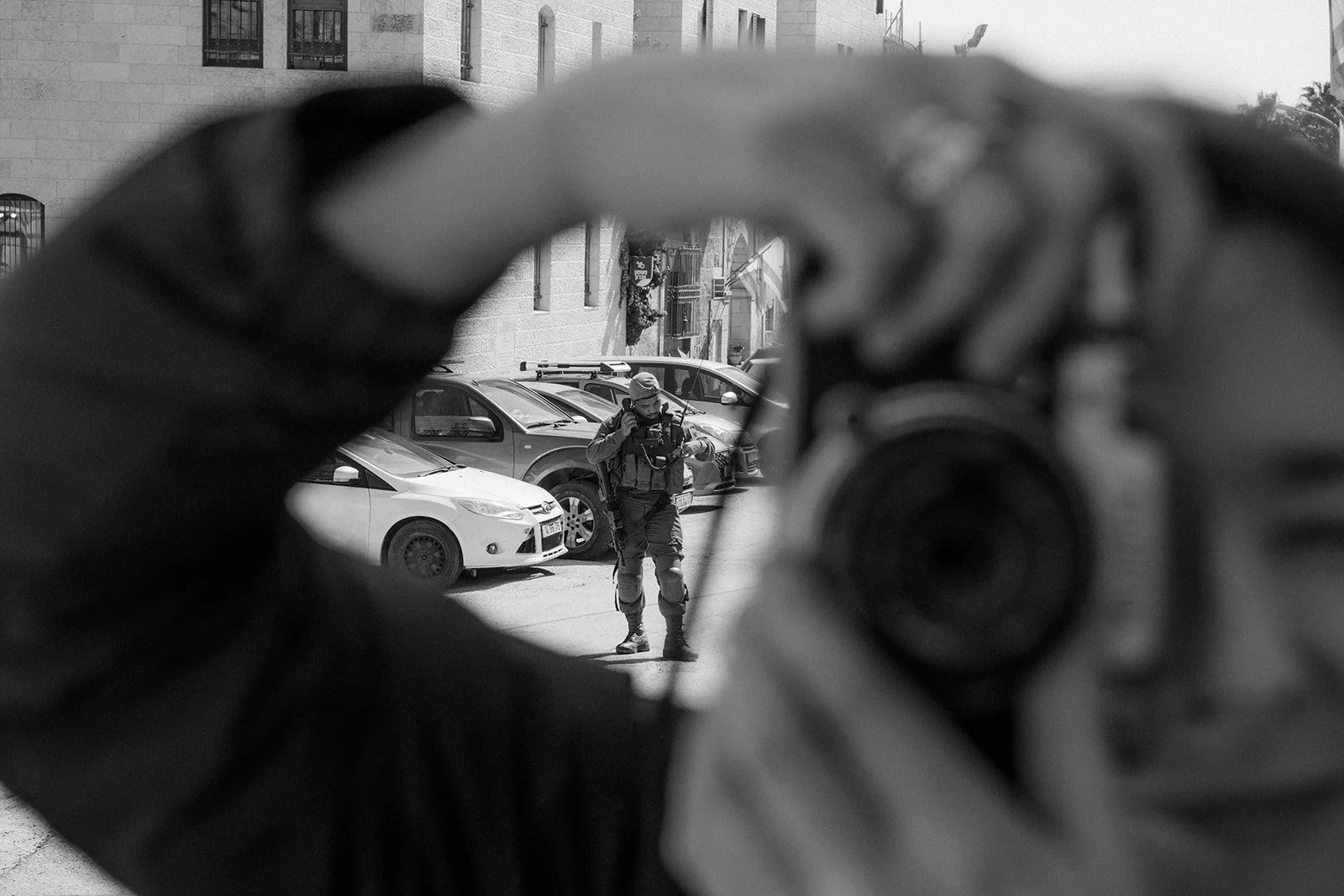
Young boy confronts a soldier outside Muneer’s shop in Al Khalil.
Coach and ACLAÍ Palestine Coordinator Athal Alazza works with a patient of the community health program,
Lajee Center Director Mohammad Alazza get arrested by forces of the occupation at Checkpoint 300.
Group photo taken in ACLAÍ Palestine opening ceremony February 2020.
Peadar walks through one of the narrow streets of the Balata refugee camp in Nablus.
A view of the apartheid wall, annexed olive groves, and nearest illegal settlement to the camp, ‘Gilo’.
Soldiers of the IOF attack the camp on foot and by jeep with tear gas launcher mounted on the jeep.
View of the camp and mosque.
Mazyouna, who’s son has been imprissoned for 29 years.
Boys smile on as they take in a demonstartion of trapeze during a circus class at ACLAÍ Palestine.
Portrait taken at the entrance to the camp and site where Aboud Shadi (13) was killed by an Israeli sniper in 2015.
Women gather at Checkpoint 300 to enter Jerusalem on the last Friday of Ramadan 2022
A red roadsign errected by the occupation warning Israeli citizens not to enter.
Portrait taken by one of the kids in the camp after Sally’s workshop.
Salah Ajarma and some of the Irish crew outside of Nablus city February 2020.
A girl hangs upsidedown during a circus class in ACLAÍ Palestine.
Aida Refugee Camp (#26, #28, #31)
The Aida refugee camp was established in 1950 on the outskirts of Bethlehem and is home to around 5800 Palestinian refugees from 27 different villages. The Aida camp is one of 24 refugee camps in the West Bank where many internally displaced persons (IDP) now live after fleeing their original villages, towns, and cities during the 1948 Nakba, and the 1967 ‘6 Day War’. When the Aida camp was started in 1950 people lived in tent structures that were later upgraded to one room huts by 1959. Later on the dwellings in the camp were rebuilt in their current form. As there is no space to expand outwards, residents of the Aida camp build upwards, often with several generations of one family living in one building. The camp has the reputation of being the most teargassed place on earth on account of how frequently the occupying forces attack the camp and you can see one example of the children of the camp being attacked by the soldiers in this video. Some of the main issues at the Aida camp reflect the issues faced by all Palestinian refugee camps; lack of space and resources, no reliable electricity or water supply, and constant attack by the forces of the occupation. While the camp was formed in 1950 as s direct consequence of the 1947 Nakba, the Nakba continues to this day through the denial of the right of return of Palestinian refugees, the illegal occupation of Palestinian lands, and the violence and control exerted over every facet of Palestinian life by the Israeli occupation.
Aida Camp Entrance (#31)
The entrance of the Aida camp is marked by an archway that sits under a huge ‘key of return’ that signifies the right of all Palestinian refugees to return to the lands, villages, towns, and cities that they had to leave on account of their illegal occupation by the occupation. The key of return not only signifies the right of Palestinian’s to return to their original homes, but to have the freedom and inherent right to travel, live, and enjoy the lands that were unrightfully stolen from them. The Lajee Center sits at the entrance of the camp within view of the arch and key, and within metres of the location that 13 year ole Aboud Shadi was shot through the chest and killed by an Israeli sniper from the military base while he stood directly outside the office of the UN with his friends on the 5th of August 2015.
Attacks and Arrests By The Occupation (#19)
The camp is in the shadow of 6 israeli watchtowers the apartheid wall. There is military base right beside the camp, and the residents of Aida life under difficult conditions imposed by the occupation. The camp is often invaded by the forces of the occupation, used to train new soldiers and test new weapons, and young people from the camp are frequently abducted and arrested from the camp frequently being lifter from their beds in the middle of the night. The occupying forces use teargas fired from handheld launchers and jeep mounted launchers, rubber coated bullets fired from M16 rifles, and live ammunition. The soldiers frequently open fire from positions outside or inside the camp, from jeeps, and also from a small opening in the door of the military base. During the last trip to Palestine in 2022 the camp was attacked frequently by the soldiers who often met resistance from the youths of the camp who came out to repel attacks by the occupation and defend the camp. In the video here you can hear the soldier in the jeep threatening to kill the polulation of the camp and torture a young boy whom they arrested to death.
Lajee Centre
The Lajee Center is located right at the entrance to the Aida refugee camp. Lajee (arabic for ‘refugee’) was started in 2000 by a group of 11 young people from the Aida camp who wanted to provide the youth of the camp with cultural, educational, social and developmental opportunities. Since starting the Lajee Center has developed several programs to serve the people of the Aida camp. The community Health Workers program that works on spreading wellness and aiding camp residents to overcome barriers that they may face in maintaining their health. Amonth the services provided by the community health workers is blood sugar and blood pressure testing with patients who are living with diabetes and hypertension. The Environmental Unit that monitors water quality in the camp and which also recently established a roof garden that provides food security for the residents who are suffering from the Israeli occupation and through these gardens they feel a sense of connection to their lands which were stolen from them. The recent attack on the Lajee center that we posted about recently severely damaged the roof garden. The media unit that documents life in the camp and the incursions and attacks that the Israeli army makes on the camp. The media unit also provides training and opportunities for young people in filming and photography. Other initiatives at the Lajee center include a children’s playground, a library, lessons in traditional Palestinian music and dance, a kindergarten, a soccer pitch, and the ACLAÍ Palestine gym.
ACLAÍ Palestine
ACLAÍ Palestine is a community gym and movement space located within the Lajee Center. The idea for the gym camp about while Ainle was taking part in the Lajee Centre’s international summer camp in August 2018. Salah Ajarma, one of Lajee’s founders and director of Lajee (until his untimely passing in April 2021) and Ainle were discussing the health issues faced by many people in the camp when the idea of opening a gym first came about. Hypertension and diabetes are among the most common health issues within the camp, and so the project. began to open a gym to help address these issues and give both young and old a space to take part in physical activity. ACLAÍ Palestine officially opened in February 2020 (#24) as a result of the hard work of our team in Ireland and Palestine, and thanks to the generous donations of the many people who backed the project through our fundraising campaign and by running small fundraising events in their own communities. ACLAÍ Palestine provides a space for strength and movement training and circus skills for people of all ages who live in the Aida camp, and also provides exercise sessions for patients of the community health program run by the Lajee Center.
The Apartheid Wall
In 2003 the Israeli occupation built the apartheid wall right next to the houses in the camp and installed 6 watchtowers that are constantly manned by soldiers of the Israeli Occupying Forces (IOF). Photo #26 was taken from the highest point in the camp and in it you see the wall clearly along with a large swath of land planted with olive trees. The land beyond the wall used to be a part of the camp and children used to play among the trees until this land was annexed by Israel when they built the wall. In this photo you can also see the nearest illegal settlement which the occupation has named ‘Gilo’ which is around 1km from Aida.
Water Supply
Israel controls the water supply into the camp resulting in poor quality of water, unreliable flow, and inadequate overall supply per capita. Control of the water infrastructure and supply is an important aspect of the occupation that is often overlooked in the international conversation surrounding the Israeli occupation, but to put the water issue in context, the World Health Organization has stated that water should be supplied at 100-120 liters per capita per day. In Aida water is at 40 liters per capita per day, while in the illegal Israeli settlements (see ‘Gilo’ in photo #26) water is supplied at 350-400 liters per capita per day. While Palestinians in refugee camps are denied a clean and reliable supply of water, many homes in settlements have swimming pools and an abundance of clean drinking water. All over the West Bank Palestinian homes are easily identifiable by the black water storage tanks that sit on the roofs of homes (#28 and #12), and it is not uncommon for settlers to fire live ammunition at Palestinian’s water tanks to rupture their tanks. The water pump in Aida is at the bottom of the hill that the camp sits on, just adjacent to the Lajee Centre (#19), and when the water supply is being restricted by Israel they often turn the pump on sporadically for a short time at inconvenient times and residents must try to store enough water to tide them over until the next time the pump is turned on. As the camp sits on a hill the water tanks fill in the houses at the bottom of the hill and works its way up. However, the water pump and supply is often turned off before the homes on higher ground have received any water. The longest length of time that the camp was denied water was 73 days.
The Burning of the Tower (#26)
Of the 6 military watchtowers that overlook the Aida camp, one such tower is situated very close to the middle of the camp, and was causing particular problems for residents who homes were under constant watch and threat from the soldiers that occupied the tower around the clock. One night in 2013 youths from the camp got together and decommissioned this particular watchtower by setting fire to it with tyres. The tower has been out of commission ever since as can be seen from Photo #26 which was taken in February 2022 by Sally.
Children’s Portraits
In advance of our trip to Palestine in february 2022 we organized a collection of DSLR cameras to bring to the Lajee Centre. In total we collected around 14 high quality digital cameras thanks to the support of our kind donors, and during the first couple of weeks of our trip Sally and Peadar held photography workshops for kids up to the age 12 at the center. After learning the basics of photography the group ventured into the camp and took portraits of each other and captured some beautiful images of life in the camp. You can see some of the results of the kids’ work in photos #20,#4, #17.
Mazyouna (#29)
Mazyouna is the 80 year old mother of Palestinian prisoner Nasser Abu Srour and lives in the Aida camp. Mazyouna witnessed the arrest of her son in 1993, who was charged with killing an Israeli Army Officer in a resistance operation for which he was sentenced to life in Israeli prison. She was deprived from visiting her son for the first 7 years of his imprisonment. Later she was allowed to visit him only once every 2 years until he has spent 20 years in prison, and then once every 2 months for the years after. Mazyouna has faith that she will witness the release of her son, and hug him under sunlight. She is fighting her age and illness and trying to maintain her sight that is getting worse as she grows older. She was promised her son will be released in a prisoner exchange deal between Palestinian Authority and the occupation and she prepared his bedroom and the welcoming ceremony for his release. However she received a phone call from an occupational officer telling her she’ll never see her son outside bars. His room is still ready for him, and his mother is still fighting her way to keep the memories she has of him outside prison.
Building the Gym
Once it was decided to embark on the ACLAÍ Palestine project to open an gym as part of the Lajee Center we set about making plans for the renovation of an old disused store room to hold the gym, plan the layout of the new facility, raise the funds to buy equipment and pay for the renovations, sourcing equipment, and crucially getting the equipment to the camp safely. To maintain our boycott of Israeli goods and services we opted to import the equipment from Berlin with the generous support of gym equipment company Strength Shop Berlin. Once we sourced the gear for ACLAÍ Palestine we arranged to import the gear to the camp through unofficial channels as the Israeli authorities have been known to confiscate similar equipment in the past if it is discovered that the equipment was to be used for the benefit of Palestinians. On the 16th of February 2020 a lorry with around 2 tonnes of gym equipment landed at the Aida camp (#15), and we promptly unloaded and assembled the gear (#6), which was a real landmark moment for the project.
The Irish Crew
From fundraising, planning, campaigning, organising, and travelling to Palestine, much of the progress of ACLAÍ Palestine is thanks to the small and dedicated crew that have contributed hugely to the project. During our trips in 2020 and 2022 we maintained the motto ‘no passengers’ in regards to our approach that each member of the crew bring their own unique set of skills to the table to contribute to the project in the best way that they can. Everyone who has played their part on the ACLAÍ Palestine crew has done so on a voluntary basis and with great energy. In 2020 (#8) the Irish crew consisted of Ainle Ó Cairealláin, Alex Sampson, Sally MacMonagle, Peadar Ó Goill, Kate Maher, and Vicky Langan. In 2022 the crew consisted of Ainle Ó Cairealláin, Sally MacMonagle, Peadar Ó Goill, and Síomha Brock (3).
ACLAÍ Palestine Staff
The success of ACLAÍ Palestine is only possible with the great work of the staff that have worked hard to build the number of participants at the gym over the last number of years, who have committed themselves to develop themselves as professional coaches, and who run the training sessions at the facility week in and week out. The Coordinator for the gym is Athal Alazza (#22) who has been involved since early 2020, and who trains over 90 women from the Aida camp and nearby Alazza camp each week ini ACLAÍ Palestine. Athal is supported in the gym by coach Mohammad Romi (#7, and#18) who runs training sessions for boys and men in the gym as well as heading the circus department as Circus Coordinator.
Checkpoint 300 (#23)
When the occupation installed the apartheid wall alongside the camp in 2003, annexing much of the land that was used by the residents of the camp, seriously curtailing the freedom of movement, and putting the Aida camp under the constant surveillance of the occupying forces, they also installed a restrictive checkpoint called Checkpoint 300 between Bethlehem and Jerusalem (#9 and #32), further restricting the movement of Palestinians and cutting them off from the old city of Jerusalem which sits around 7km from Bethlehem and which also has many of the most holy sites in Islam. On the last Friday of Ramadan 2022 Mohammad Alazza and I walked to Checkpoint 300 to document the forces of the occupation as they restricted men and women from getting to Jerusalem on one of the most holy days. When the soldiers realised that we were there to film and photograph at the women’s side of the checkpoint them they became aggressive and arrested Mohammad forcefully (#23). After his release about an hour later we continued to document the soldiers on the men’s side of the checkpoint (#9).
Al Khalil (Hebron)
Al Khalil is the biggest city in the West Bank and suffers at the hands of the occupation in a unique way in that there are over 50 checkpoints in the old city area and settlers have taken over buildings the used to be schools and Palestinian homes which are subsequently guarded by Israeli soldiers. Streets in the old city are covered in wire mesh to try and protect Palestinian traders from rocks, rubbish, bricks, and debris thrown by soldiers and settlers. In 1994 an American settler called Baruch Goldstein entered the Al Ibrahimi and murdered 29 Palestinians while they were praying and wounding a further 125. After the massacre Israeli forces closed the main shopping street of Hebron, Al Shuada Street, welding the doors of the shops closed and denying the many traders access to the street, their shops, and even the goods that were inside the shops. Over the years we have gotten to know Abdallah very well, and he has been our tour guide in Al Khalil on every trip (#12). Over the years since the first visit to Palestine in 2018 things have got markedly worse in Al Khalil in terms of the restrictions placed on Palestinians there and also in terms of how dangerous and challenging it is to give tours around the old city. Abdallah introduced us to Muneer (#16), a shopkeeper who managed to keep his shop open for 20 years despite not having a single customer because of the closure of Shuada Street. Muneer is known locally as ‘The Legend’ for his resilience in the face of Israeli occupation. We call in to Muneer to buy gifts to bring home and to catch up with him on each visit to Palestine. When we visited Muneer in 2022 clashes broke out in front of his shop that resulted in the near arrest of one of our coaches when she was escorting a young boy to his home when the trouble kicked off minutes after Photo #21 was taken. She was roughly handled by soldiers and the local commander, but managed to get away from them eventually and retreat to Muneer’s shop for cover, minus one of the arms from her jacket.